
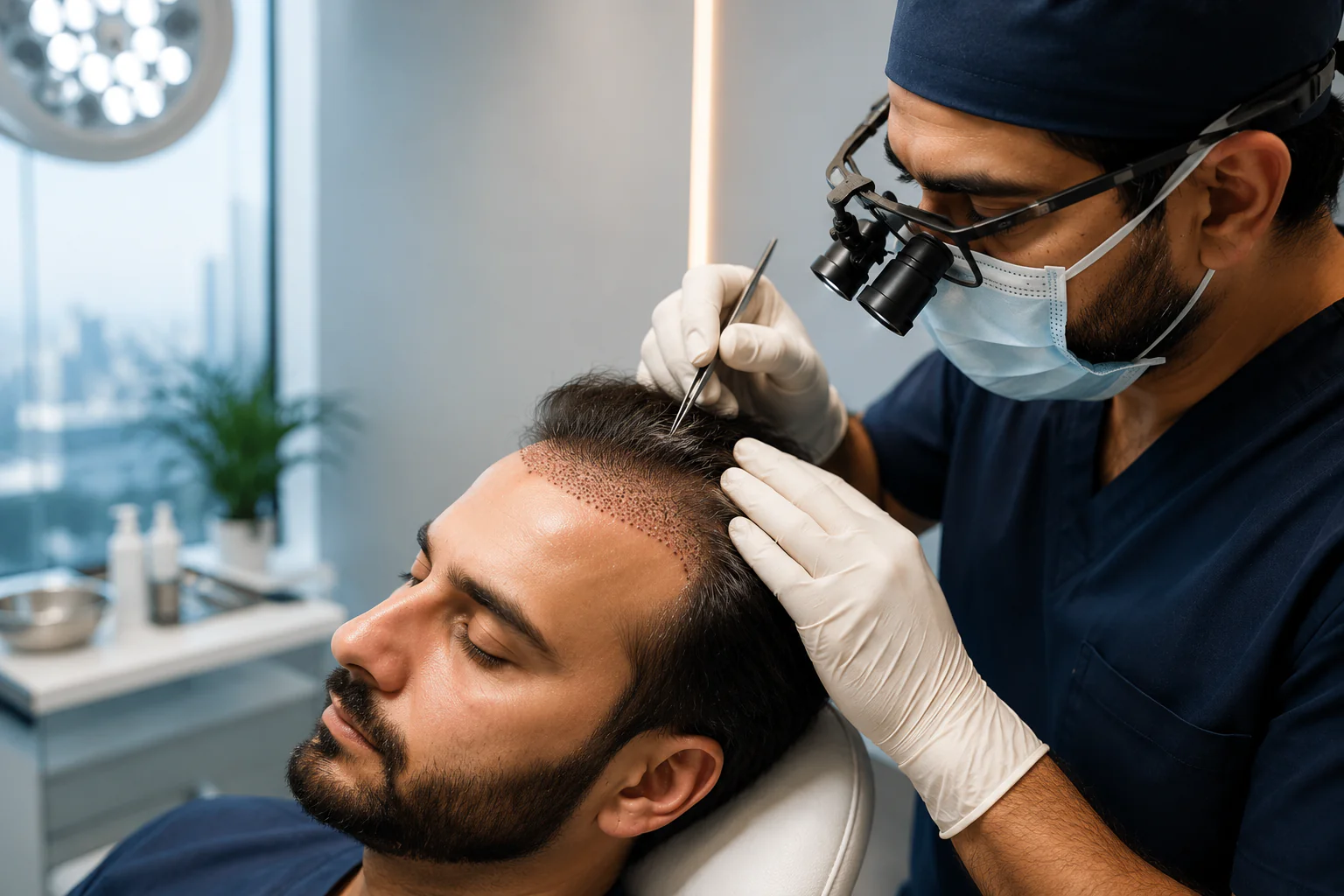

Thousands of UAE residents fly out for discounted hair restoration every year. Most come back happy. The ones who don’t are finding out that fixing it is harder, slower and more expensive than the original — and a lot of them are ending up in India.
First, the honest bit
Most hair transplants done abroad turn out fine.
That needs saying up front, because there’s a whole genre of scare content about this and most of it is written by clinics that want your business. Plenty of people fly out, have a good experience, come home with hair, and never think about it again.
This piece isn’t about them. It’s about the smaller group who don’t — and about the thing almost nobody explains before you book, which is what happens if you land in that group.
The scale of it
Turkey is the centre of this industry, by a distance. It handled more than 1.5 million procedures in 2024 — over 60% of the world’s hair transplant tourism — at prices roughly 60 to 80 percent below US rates. That’s not a scandal, that’s a functioning market, and it’s why so many people from the Gulf go.
The thing worth knowing sits alongside it. The International Society of Hair Restoration Surgery, the main professional body for the field, surveys its members every year. In 2025, 59.4% of them said they’d seen black-market or unqualified-technician clinics operating in their own cities — up from 51% in 2021. The same body reported that 10% of the repair cases its members handled in 2024 traced back to a black-market procedure, nearly double the 6% recorded three years earlier.
That’s a global finding about unqualified operators everywhere, not a verdict on any one country. But it’s the backdrop to the trip.
What actually goes wrong
When a transplant fails, it usually fails in one of four ways. None of them are dramatic. That’s part of the problem.
They take too much from the back of your head. This is the big one, and most people have never heard of it. The hair on the back and sides of your scalp is your donor supply, it’s finite, and it doesn’t regenerate. Take too much and the donor area itself starts looking visibly thin. Surgeons who handle revision work describe this as the most consequential problem they see, partly because it uses up the follicles you’d need for any future correction, and partly because it often doesn’t show for years — by which point your options have narrowed considerably.
The hairline is wrong. Too low, too straight, or set at the wrong angle for your face. It can look acceptable at 28 and strange at 40, as the native hair around it keeps receding and the transplanted line stays exactly where it was put.
The grafts don’t survive. How follicles are handled and how long they spend outside the body during surgery decides whether they take. You won’t know either way for the better part of a year.
You’re not certain who operated on you. Worth asking about, simply because it’s the question most people don’t think to ask until afterwards.
Why none of this comes up beforehand
Look at how the thing is actually sold.
You see it on Instagram or TikTok. You message an account, often an agency rather than the clinic itself. Someone quotes you a graft number — 4,000, 5,000 — over WhatsApp, before anyone has looked at your scalp in person. The price includes flights, hotel, airport transfers. It’s four days, start to finish.
Then you fly home.
And that’s the structural bit: there is no follow-up built into the model, because the model was never designed around a twelve-month timeline. Nobody’s hiding anything. It’s just that a transplant reveals itself slowly and the transaction ended the moment you cleared passport control.
The part that surprises people: fixing it is the hard bit
Here’s the thing most patients get wrong. They assume that if it goes badly, they’ll just get it redone properly.
Revision work is widely described by surgeons in the field as some of the most difficult work they do — harder than a first-time procedure, not easier. The surgeon is working inside limits somebody else created: a reduced donor supply, scar tissue where the grafts went in, and existing grafts sitting in the wrong places that may need removing before anything new goes in.
Some surgeons won’t take these cases at all. The outcome is less predictable, and they’d be taking on responsibility for work they didn’t do.
And there’s a waiting period. You generally can’t even be properly assessed until nine to twelve months after the original surgery, because the grafts need to fully mature before anyone can see what’s actually there.
So: a longer wait, a harder operation, sometimes two or three staged procedures, and a bill higher than the first one.
Which is how (some) people end up in India
Home to some of the best surgeons and clinics for hair transplant, India has been the go-to place for many folks who are looking for the best treatment for their hair.
Even in cases where repair is needed, a lot of qualified people will lead you to India.
While doing the research, we were able to speak with a reputed hair transplant clinic from Gurugram, India – the caseload over there has been immense overall, with a lot of individuals from the UAE and GCC visiting for their treatment.
India isn’t magic either
Worth being straight about this, because the country isn’t the variable.
India has its own problem with unqualified people doing this surgery, and it’s been in the courts. Two men died within 48 hours of hair transplant procedures in Kanpur, allegedly carried out by a practitioner who held only a dental degree and had marketed herself online as a hair transplant specialist. Separately, the Delhi High Court has raised concerns about salons offering hair transplants without any medical supervision, and stated that the procedure needs to be done by a qualified dermatologist or a trained surgeon.
So the lesson isn’t “go to India instead of Turkey.”
It’s that this was never a question about countries. It’s a question about whether a qualified surgeon is doing your actual surgery — and that varies enormously within Istanbul, within Delhi, and within Dubai. The passport on the clinic’s wall tells you very little. The surgeon’s credentials tell you almost everything.
Before you book: eight questions to ask
- Who physically makes the incisions and places the grafts — is it the doctor, and will the doctor be in the room the whole time?
- What’s your licence number, and which authority issued it?
- How many grafts can my donor area give me across my entire life — not just in this session?
- Why are you quoting me a graft count before examining me in person?
- What happens at twelve months if I’m not happy? Is that commitment in writing?
- Can I speak to a patient you operated on two years ago — not two months ago?
- Who do I call from Dubai at 2am if something goes wrong?
- Are you registered with the ISHRS or ABHRS, and can I verify that myself?
And if you’re having it done here in the UAE, you can check any doctor’s licence yourself in about a minute. Dubai practitioners are listed on the DHA’s Sheryan portal, Abu Dhabi and Al Ain on the Department of Health portal, and Sharjah, Ajman, Fujairah, Ras Al Khaimah and Umm Al Quwain through MOHAP. A licence issued in one emirate doesn’t automatically carry to another, so check the one that matches where the clinic actually is.
[REPORTING NEEDED — CLOSING] Return to the patient from the opening. About 150 words. Needed: what he’s spent in total across both surgeries, where he is now, and one line in his own words about what he’d do differently. End on his quote. Do not add a summarising paragraph afterwards.
Sources for fact-checking
- International Society of Hair Restoration Surgery (ISHRS) — annual practice census, 2025 and 2021 figures; ISHRS public awareness campaign on unlicensed practice
- Global hair transplant tourism volume and pricing differential, 2024 figures
- Kanpur hair transplant deaths — police complaint and subsequent reporting, 2025
- Delhi High Court observations on unsupervised hair transplant procedures, 2022
- DHA Sheryan portal; Department of Health – Abu Dhabi; MOHAP practitioner registers
Note for the editor: the ISHRS and BAAPS figures should be pulled and linked from the primary source documents rather than from secondary coverage. Nearly all secondary reporting on this subject is published by clinics with a commercial interest in the conclusion, and the numbers should be verified against the original surveys before publication.
