
















Research peptides are now ordered across the Gulf every day, by university labs, contract researchers and independent scientists. The market has grown faster than the paperwork behind it. Some suppliers publish independent test results for every batch. Others show one old certificate for everything they sell, or nothing at all.
This guide sets out what a laboratory in the UAE, Saudi Arabia, Qatar, Kuwait, Bahrain or Oman should check before placing an order. None of it depends on which supplier you choose. It is simply the standard any supplier should be able to meet.
Quick answer: before you order, check four things. First, an independent certificate for the batch you will receive. Second, a storage claim that matches the format. Third, a written delivery time and fee for your country. Fourth, clear research-use labelling with no health claims. A supplier that cannot show all four in writing is asking you to take its word for it.
1. Certificates: one batch, one report, one independent lab
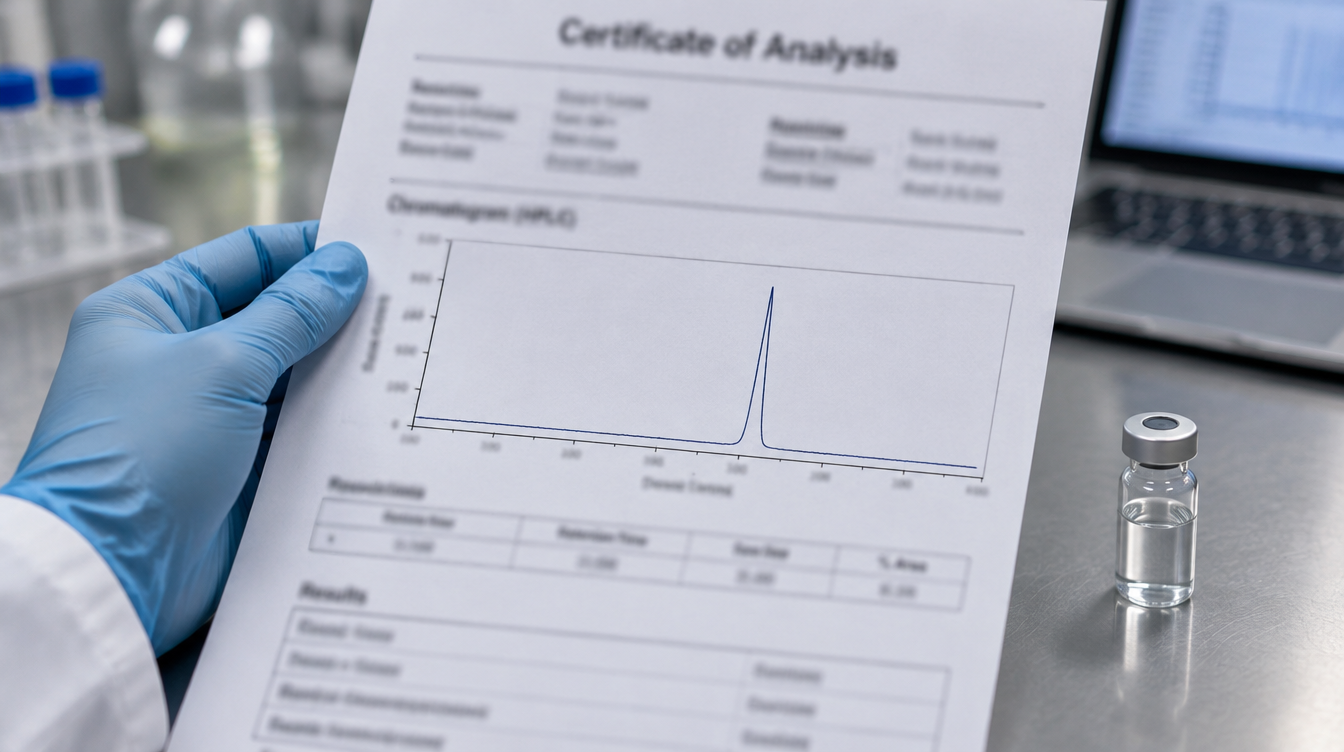
A certificate of analysis describes one sample from one production batch, tested on one date. It says nothing reliable about a different batch, even of the same compound. So the first question is not “do you have a COA?” but “which batch will I receive, and where is its report?”
A useful certificate shows at least five things:
- The laboratory’s name, and it should be independent of the seller. A report produced in-house is a claim, not a test.
- A batch or sample reference that the supplier can tie to your order.
- HPLC purity, the share of detected material that is the target peptide.
- Measured content in milligrams. A vial labelled 10 mg can be 99% pure and still hold 8 mg.
- Identity by mass spectrometry. Purity alone cannot prove which peptide is in the vial.
Then verify it. Established testing laboratories such as Janoshik Analytical let you check a report on their own website. Open the link from the laboratory’s site, not from a screenshot or a forwarded PDF, and confirm the compound, sample and date match.
The better suppliers make this easy. Dubai-based SHLabz, for example, publishes its batch certificates in a searchable public library, each with a link to verify it on the laboratory’s site, and will tell you which batch your order came from. Use that as a benchmark: if another supplier cannot do the same, ask why.
2. Storage: the format decides, not the weather
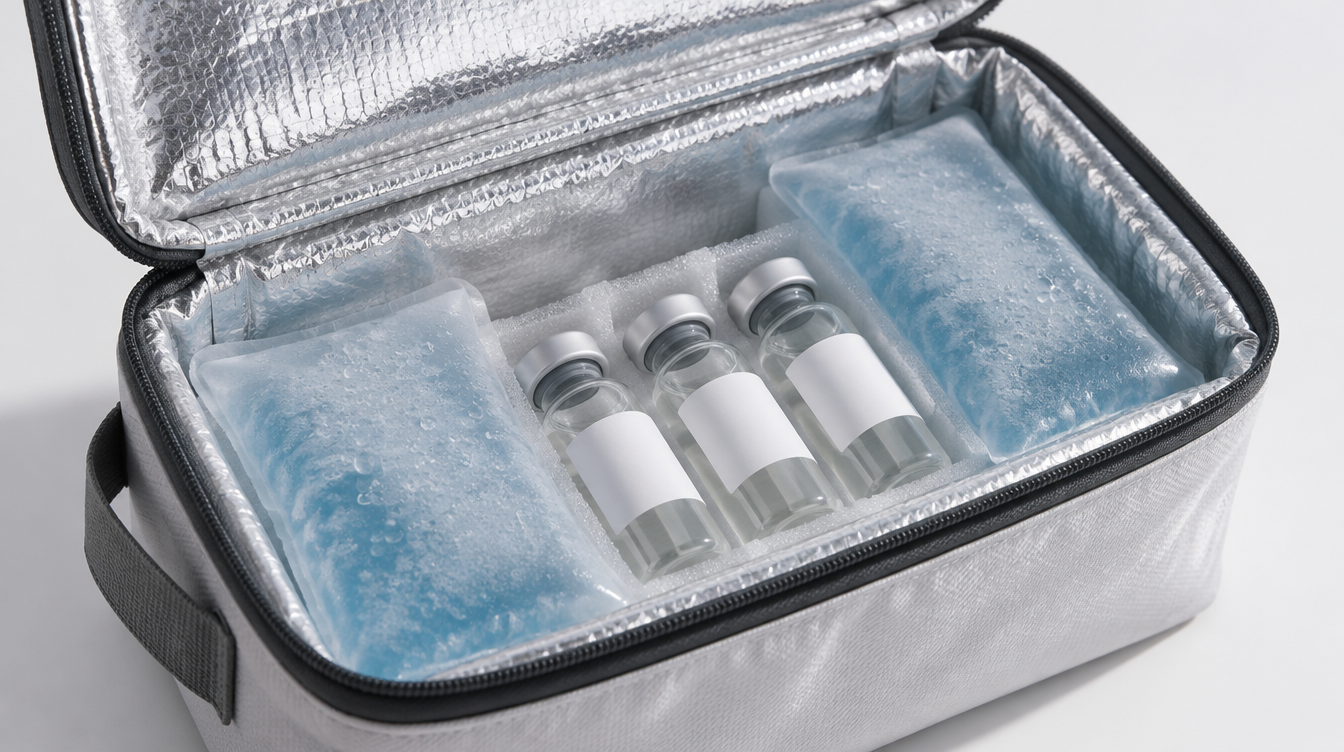
Gulf summers regularly pass 45 °C, so storage is the question buyers worry about most. The honest answer depends on the format.
| Format | What it is | Storage | Can it travel across the GCC? |
| Lyophilised vial (sealed) | Freeze-dried powder under a crimped cap | Room temperature, dry and dark | Yes |
| Reconstituted vial | Powder mixed into solution | 2 to 8 °C, never frozen | Not recommended |
| Pen or cartridge | Peptide already in solution | 2 to 8 °C from arrival | Short domestic routes only |
| Nasal spray | Pre-mixed solution in a metered bottle | 2 to 8 °C | Short domestic routes only |
| Topical serum or spray | Ready-made preparation | Room temperature | Yes |
A sealed freeze-dried vial contains almost no water, so the reactions that break peptides down run very slowly. The real risks are moisture, light and a damaged seal. Condensation is the classic Gulf mistake: a cold vial opened straight away in humid air pulls water onto the powder. Let it reach room temperature first.
Liquids are different. Anything already in solution needs a cold chain from the warehouse to your fridge. That is why a careful supplier will ship sealed vials across the region but keep pens and sprays to domestic, cold-packed delivery.
Red flag: a seller who says sealed powder must be frozen, or who offers to post a liquid format across a border with no cold chain. Either claim tells you how well they understand the material.
3. Delivery: local stock beats long transit
Where the stock sits matters more than any promise on the homepage. A parcel shipped from inside the region avoids international customs, long transit in hot cargo holds and the uncertainty of a package held at the border.
What to ask for, in writing:
- A cut-off time. “Same day” means nothing without one. A real offer reads like “orders before 12:00 on a working day”.
- Times by country. Within the UAE, a local supplier should manage same-day or next-day delivery. Elsewhere in the GCC, 2 to 5 working days is a realistic range.
- Fees by country, and the order value at which delivery becomes free.
- Which formats ship where. As above, liquids should stay within short, cold-packed routes.
- What happens if a parcel arrives damaged, and what photos or details you will need to send.
As a reference point, a UAE-stocked supplier such as SHLabz delivers within the UAE the same day for orders placed before 12:00 on a working day, cold-packed, and ships sealed vials to Saudi Arabia, Qatar, Kuwait, Bahrain and Oman. Its pens and nasal sprays stay within the UAE, which is the correct call for liquid formats.
4. Payment and paperwork
Payment methods say a lot about how a business operates. Card payments, Apple Pay and regulated instalment services such as Tamara all involve checks on the merchant. A seller that accepts only bank transfers to a personal account, or only cryptocurrency, gives you no protection if something goes wrong.
Keep the invoice, the order confirmation, the tracking record and the batch certificate together. For an institutional lab, that file is your audit trail.
5. Research-use labelling
Research peptides are sold for laboratory research, not as medicines. A responsible supplier says so clearly and consistently. It describes compounds and the published research on them, and it does not give dosing advice or promise effects on people. Regulators in the region have acted against sellers who market these products as treatments, so a supplier’s language is also a guide to how long it is likely to stay in business.
Seven red flags
- One certificate reused for every batch, or no certificate at all.
- Certificates with no laboratory name, or one that cannot be verified on the lab’s own site.
- A supplier that cannot tell you which batch your order came from.
- Health claims, before-and-after photos or dosing instructions.
- “Same day” with no cut-off time.
- Liquid formats posted across borders with no cold chain.
- Prices far below everyone else. Independent testing costs money, and a price that leaves no room for it usually means there was none.
A five-minute checklist
- ☐ Independent certificate for the batch you will receive, verified on the lab’s own site
- ☐ Purity, content in mg and identity by mass spectrometry all reported
- ☐ Storage advice that matches the format
- ☐ Written delivery time, fee and cut-off for your country
- ☐ Traceable payment methods
- ☐ Clear research-use labelling, no health claims
The short version
In the UAE and the wider GCC, the gap between careful and careless suppliers is wide, and it is visible in the paperwork. Ask for the batch certificate, check it at the source, match the storage claim to the format, and get delivery terms in writing. For a deeper look at handling in Gulf heat, this guide to peptide storage in the UAE and GCC covers each format in detail.
This article is for general information about laboratory research materials. It is not medical or legal advice.