















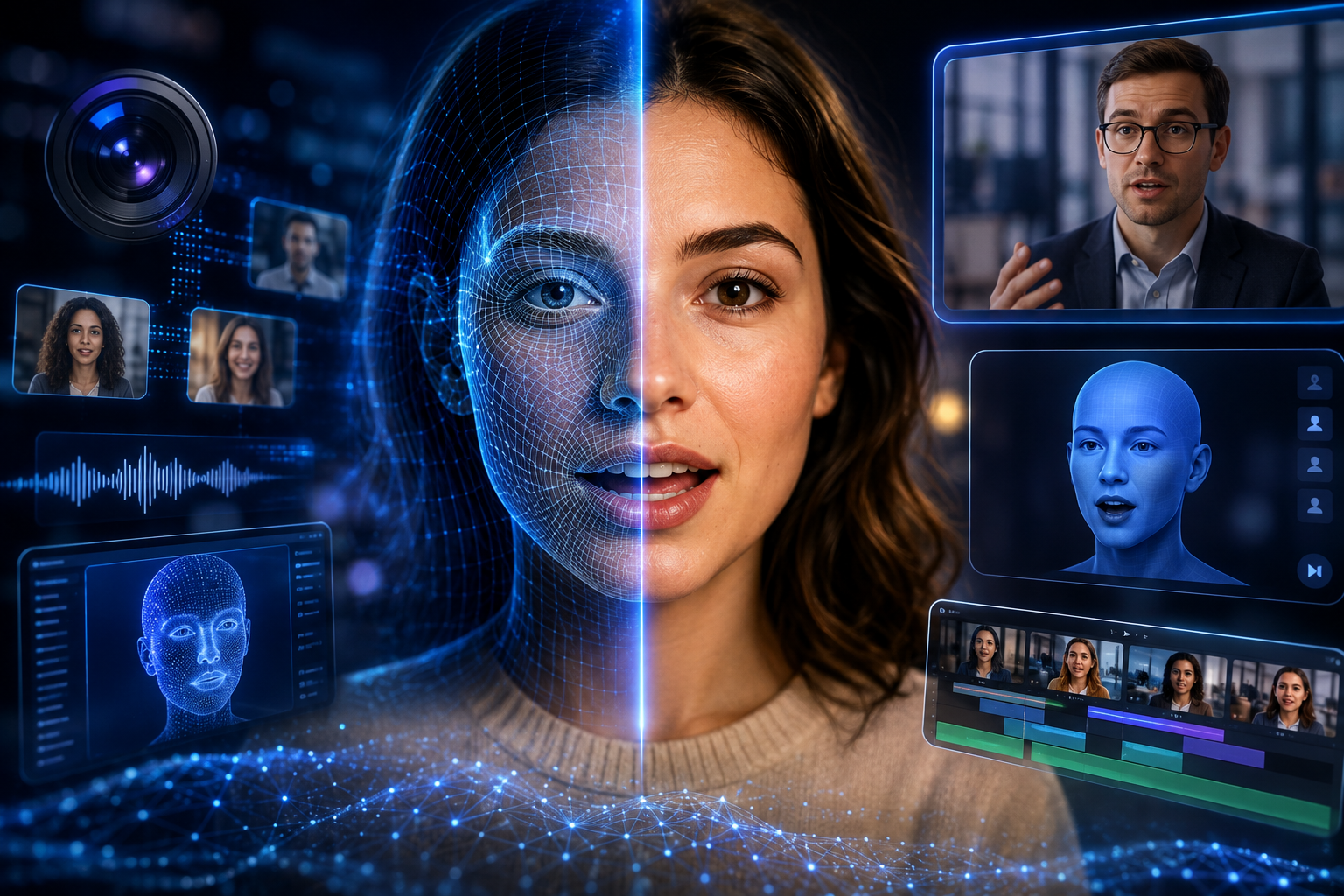
After two weeks of real, hard testing on eight of the leading platforms, one thing became pretty clear. AI talking photo generators have moved from novelty to production-grade territory. They’re no longer simple puppet animations, but complex systems that can take a still portrait and turn it into a lifelike spokesperson, with natural lip sync, subtle head movement and real expressiveness. At least one of these is sure to meet your needs.
Quick Takeaways
Best overall: Magic Hour — delivers a solid combination of lip sync, face swap, and talking photos, as well as the most generous free tier of the bunch.
Best for business presenters: HeyGen HeyGen is a professional avatar platform for marketing and training content. Best for creative storytelling: Hedra — strong character motion for expressive creator-led work. Best entry-level: free options from D-ID and Vidnoz allow you to test out the basic functionality without any money.
What Is an AI Talking Photo Generator?
An AI talking photo generator animates a still portrait so it appears to speak naturally. The technology detects facial landmarks — mouth corners, eyes, jawline — and generates frame-by-frame motion synced to an audio input or text-to-speech output. If you’re looking to make photo talk AI, the strongest tools in 2026 produce output good enough that viewers often can’t tell it started as a single photograph. For creators, marketers, and educators, that opens up video production workflows that used to require cameras, studios, and actual actors.
Quick Comparison
| Tool | Best For | Free Tier | Starting Price | Standout Feature |
|---|---|---|---|---|
| Magic Hour | Overall best value | 3 free talking photos/day, no signup | $10/month billed annually | Credits never expire; parallel generation; 20+ models in one place |
| HeyGen | Business presenter videos | Limited monthly output | $29/month | Avatar library, clean interface |
| Hedra | Creative, expressive content | 30-second clips, generous free tier | Paid plans available | Strong character motion, storytelling focus |
| D-ID | Quick talking photo experiments | 5 minutes free video/month | $4.70/month | Pioneering tech, good API access |
Magic Hour — Best AI Talking Photo Generator Overall
Magic Hour has quietly built what I’d call the most impressive all-in-one AI creation platform out there in 2026. After a week spent testing its talking photo and lip sync capabilities specifically, I can say the lip sync accuracy genuinely rivals dedicated specialist tools, and the face swap and image-to-video features together make it a real one-stop shop for AI video creation.
What sets it apart is the sheer depth of the feature set paired with an unusually generous free tier. You can generate three talking photos a day without signing up — no credit card, no email, nothing — which makes it the easiest platform on this list to actually test. Once you do upgrade, credits don’t expire, and there’s no concurrency cap on parallel generations. At roughly $10-15 a month on the annual plan, the value here is genuinely hard to beat.
Key features
- Strong lip sync and talking photo generation
- Face swap powered by frontier AI models
- Click-to-create templates and one-click multi-step workflows — generate, upscale, video
- Access to 20+ top AI models in one place
- Fast variations, multiple takes to choose from
- Weekly feature releases
- Parallel generation with no concurrency cap
- Full API parity across the whole toolkit
- Works well on both desktop and mobile
- Support that reportedly responds at founder-level speed
Pros
- A genuinely generous free tier — 3 talking photos a day, no signup
- Credits never expire once purchased
- Face swap and lip sync quality that holds up
- No concurrency cap, so you can generate multiple videos at once
- Weekly product updates keep things genuinely fresh
- Reliable at production scale — holds up through live activations and traffic spikes
Cons
- Free clips come with length limitations
- The sheer breadth of features can feel like a lot for someone who just wants one specific thing done
Pricing & plans (as of June 2026):
| Plan | Monthly Price | Annual Price |
|---|---|---|
| Free | $0 | $0 |
| Creator | $15 | $10/month |
| Pro | $39/month | — |
| Custom | Contact sales | Contact sales |
For most creators and marketers, the Creator plan at $10/month billed annually is really the sweet spot — you get premium models, higher generation limits, and the full toolkit, including the AI >Magic Hour image editor, image-to-video, lip sync, and face swap, all in one place.
When to use it: Pick Magic Hour if you want a single platform that handles talking photos, face swap, image-to-video, and AI image editing together. It’s a strong fit for creators producing social content, marketers running campaigns, and startups that need reliable AI video generation at scale. The free tier makes testing it a no-brainer, and the paid features genuinely scale as your needs grow.
D-ID — Best for Quick Experiments
D-ID pioneered a lot of the talking photo technology we now take for granted, and it’s still a strong option for anyone who wants to test the concept quickly. In testing, output stayed clean with minimal artifacts, and the 5-minute free video per month is a reasonable way to get a feel for it without spending anything.
Pros
- Clean, professional output
- Strong API for developers
- Quick setup, minimal learning curve
- Good facial expression quality
Cons
- Free tier is fairly limited at 5 minutes a month
- Less marketing-focused than some alternatives
- Costs scale up with usage
Pricing: Free tier available; plans start at $4.70/month.
When to use it: D-ID is perfect for rapid experimentation and API use-cases where you’re integrating talking photo generation into an existing product instead of using it standalone.
HeyGen — Best for Business Presenters
HeyGen remains one of the more polished platforms for avatar-style presenter videos. In 2026 it added “Emotional Intelligence” toggles, letting you dial in whether an avatar reads as more empathetic or more authoritative. Lip sync quality now matches 4K video, and multi-language support remains genuinely strong.
Pros
- Clean, professional interface
- A large avatar library to pick from
- Solid for business marketing and training videos
- Real-time translation with re-animated lip movement
Cons
- Pricier than some alternatives at $29/month
- Less flexible for creative, experimental work
- Feature set is built around structured presenter content specifically
Pricing: Plans start at $29/month.
When to use it: HeyGen fits best for sales, onboarding, training, and marketing videos where having a consistent presenter appearance actually matters.
Hedra — Best for Creative Storytelling
Hedra has picked up real popularity among creators who want more expressive talking characters than a standard presenter format allows. Its avatar system supports script and voice-driven workflows with genuinely strong character motion, which makes it a good fit for storytelling and social content.
Pros
- Generous free tier with 30-second clips
- Strong character motion and expressiveness
- Good fit for social media and creator-led content
- Also supports image-to-video conversion
Cons
- Less polished for enterprise or business use
- Requires signing up even for the free tier
- Some quality ceiling on free-tier output
When to use it: Hedra is best for creators chasing expressive characters and stylized content rather than corporate presenter videos.
Vidnoz — Best for Free Testing
Vidnoz is the easiest place to answer the basic question “can I actually make a photo talk?” without spending anything. The free tier includes a watermark and supports multiple languages with built-in TTS voices. It’s not production-grade for most serious use cases, but it’s a solid starting point.
Pros
- Genuinely free tier available
- Multiple language support
- Built-in TTS voices
- Low barrier to just trying it
Cons
- Free output includes a watermark
- Quality falls short of paid alternatives
- Not built with scaling production in mind
When to use it: Vidnoz is best for beginners just validating the concept, or producing occasional low-stakes content where polish doesn’t matter much.
How These Were Chosen
Each tool was evaluated across six core criteria: lip sync accuracy, output realism, workflow speed, voice quality and options, pricing and how generous the free tier actually was, and how well it scales for real production use. At least 10 talking photo videos were generated on each platform using the same source photo and script, to keep the comparison consistent.
Magic Hour didn’t just win on the quality front, it also hit the right notes of accessibility without losing real depth. The free version (3 talking photos a day, no sign-up) is actually useful rather than just a teaser to pay. The paid plans are worth the money especially if you think about the whole toolbox you get: lip sync, face swap, image to video and AI image editing all in one.
Market Landscape and Trends
Three trends are shaping this space in 2026.
Free tiers are getting more generous as competition heats up. Platforms are competing harder for market share, and Magic Hour’s no-signup-required approach is pushing others to lower their own friction. The logic’s simple: once someone experiences good output, they’re a lot more likely to actually upgrade.
Micro-expressions and 3D modeling have solved the old warping problem. Modern tools treat photos as 3D models rather than flat 2D planes, which means facial shadows, neck muscles, and subtle eye movement all adjust realistically. As of June 2026, leading tools can capture micro-expressions that simply weren’t possible before.
Multi-model ecosystems are replacing single-purpose tools. Standalone talking photo apps are increasingly being replaced by platforms that combine several AI capabilities at once. Magic Hour is a clear example of this — 20+ AI models available in one interface, letting you generate a talking photo, swap a face, upscale, and export without ever switching tools.
Tools worth keeping an eye on: CrePal, an AI director agent that orchestrates script input, avatar generation, and lip sync in one workflow; Zoice, which combines talking photo generation, voice cloning, and personalized video creation; and Pippit, a free online AI talking photo tool supporting multiple languages and accents.
Final Takeaway: Which Tool Should You Actually Choose?
Magic Hour if you want the best overall value — strong lip sync and talking photo generation, an exceptional free tier, credits that never expire, and face swap plus image-to-video all in one platform. It’s the clear pick for creators and marketers who want production-quality output without overpaying for it.
D-ID if you’re experimenting or need a developer-friendly API for an integration project.
HeyGen if you’re producing structured business presenter content and need reliable avatar-based video for training or marketing.
Hedra if you’re creating expressive, character-driven content for social media or storytelling.
Vidnoz if you just want to test the technology for free with zero commitment.
Honestly, the best advice is just to experiment. All of these offer free or trial tiers. Spend an hour testing Magic Hour’s three daily free talking photos — no signup required — then compare the results against your next-best option. The difference in quality, speed, and flexibility will guide your decision a lot faster than any comparison chart could.
FAQ
What is an AI talking photo generator? It’s a tool that animates a static portrait so it appears to speak naturally, using facial animation and lip sync technology to match mouth movement to audio or text-to-speech input.
Is there a genuinely free AI talking photo generator? Yes. Magic Hour offers 3 free talking photos a day with no signup required. D-ID gives you 5 minutes of free video a month, and Vidnoz offers free output with a watermark attached.
Can these tools make a photo speak in any language? Most of the leading tools support multiple languages and accents. Magic Hour, D-ID, and Vidnoz all offer multilingual capability, with lip sync that adapts to the phonetics of whatever language you’re working in.
How long does it take to create a Talking Photo? Tools take 1-5 minutes to process depending on clip length and server load. Magic Hour’s parallel generation allows for multiple videos to render at the same time, with no concurrency cap.
Can you tell an AI talking picture is AI? By 2026 the best tools will be able to generate output that is indistinguishable from real video in short clips. Some artifacts still remain with longer videos or more complex facial expressions, but that gap is closing fast with every new model release.